8th webinar
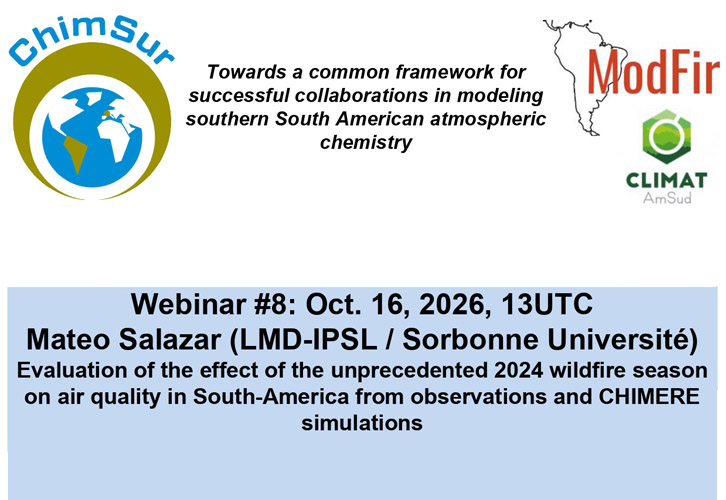
Who? Mateo Salazar (LMD-IPSL/Sorbonne Université)
When? 16 October 2026, 13hs UTC (10:00 Argentina, 15:00 France)
Where? Online at Visio (link)
Abstract
During 2024, South America experienced one of the most intense fire seasons observed in recent decades, with fire activity concentrated primarily in the Amazon Forest and the Pantanal-Chiquitano region. We studied the impact of these wildfire emissions on air quality across the continent using a combination of in-situ observations, gathered from official and open-access networks, and simulations performed with the CHIMERE chemistry-transport model with APIFLAME emissions. Model outputs were combined with PM2.5 measurements from over 400 locations across the continent, allowing us to quantify the impact of these wildfires on atmospheric pollution during this period.
Our results show that many South American cities were strongly affected by the fires, with concentrations frequently exceeding the World Health Organization’s recommended limit (15 μg/m³). Seasonal-averaged values surpassed 40 μg/m³ in Santa Cruz, Bolivia, and Rio Branco, Brazil, and exceeded 15 μg/m³ in many cities located further from the hotspots, across Brazil, Bolivia, Paraguay, Peru, and Colombia. These results, combined with simulation estimates, suggest that more than 170 million people were exposed to PM2.5 concentrations that exceeded the WHO Air Quality Guidelines as a direct result of wildfire emissions.
ChimSur Webinars: Towards a common framework for successful collaborations in modeling southern South American atmospheric chemistry
This webinar series has been created in the context of a scientific project funded by CNRS (France) that started last year: IRN ChimSur: Characterizing spatial-temporal evolution of atmospheric composition in the south cone with CHIMERE. Sylvain Mailler (LMD-CNRS, France) is the PI of this project, with other participants from LMD, as well as from IFAECI (Argentina-France), Instituto Gulich (Argentina), and Universidad de Chile (Chile).
